


The World as a Living Syllabus
What if every moment of your life was a carefully woven lesson, subtle in its delivery, precise in its unfolding, and intricately designed for the evolution of your being?
What if the patterns within your days, the contours of your relationships, and the architecture of your routines and disruptions were not arbitrary, but intentional? What if they served as a living syllabus, gently revealing the virtues you are here to awaken and embody?
This article explores a simple yet transformative idea: all material forms within space and time are expressions of divine principles. They are living reflections of dharma, the inherent nature of the divine, refracted into experience. The more consciously we attune to the virtues being communicated through our circumstances, the more gracefully we are able to evolve. Growth, then, becomes a refinement in our ability to listen. Each moment becomes a sacred whisper, guiding us inward.
Rishi Prakasa once observed:
“In nature, form gives rise to function, function reflects principle, and principle reveals virtue.”
This insight offers a luminous lens through which to interpret the choreography of life. Distilled to its essence, the progression may be understood as:
form → function → principle → virtue
In this continuum, the shape of a thing determines its function. That function reveals the principle that animates it. And when that principle is contemplated, lived, and integrated, it blossoms into virtue within the human spirit. This elegant sequence echoes ancient metaphysical teachings, yet speaks directly to the needs of our modern lives.
As we recognise the dialogue between our inner world and the events that surround us, we begin to see life itself as a curriculum. Each experience mirrors the moral and energetic qualities we are being called to refine. This is the path of dharma, expressed as a living relationship with reality. Just as leaves, shells, and galaxies spiral in accordance with divine geometry, our own lives spiral toward remembrance. Through this unfolding, we are drawn back to who we truly are: living embodiments of dharmic virtue, returning to our original design through the poetry of experience.
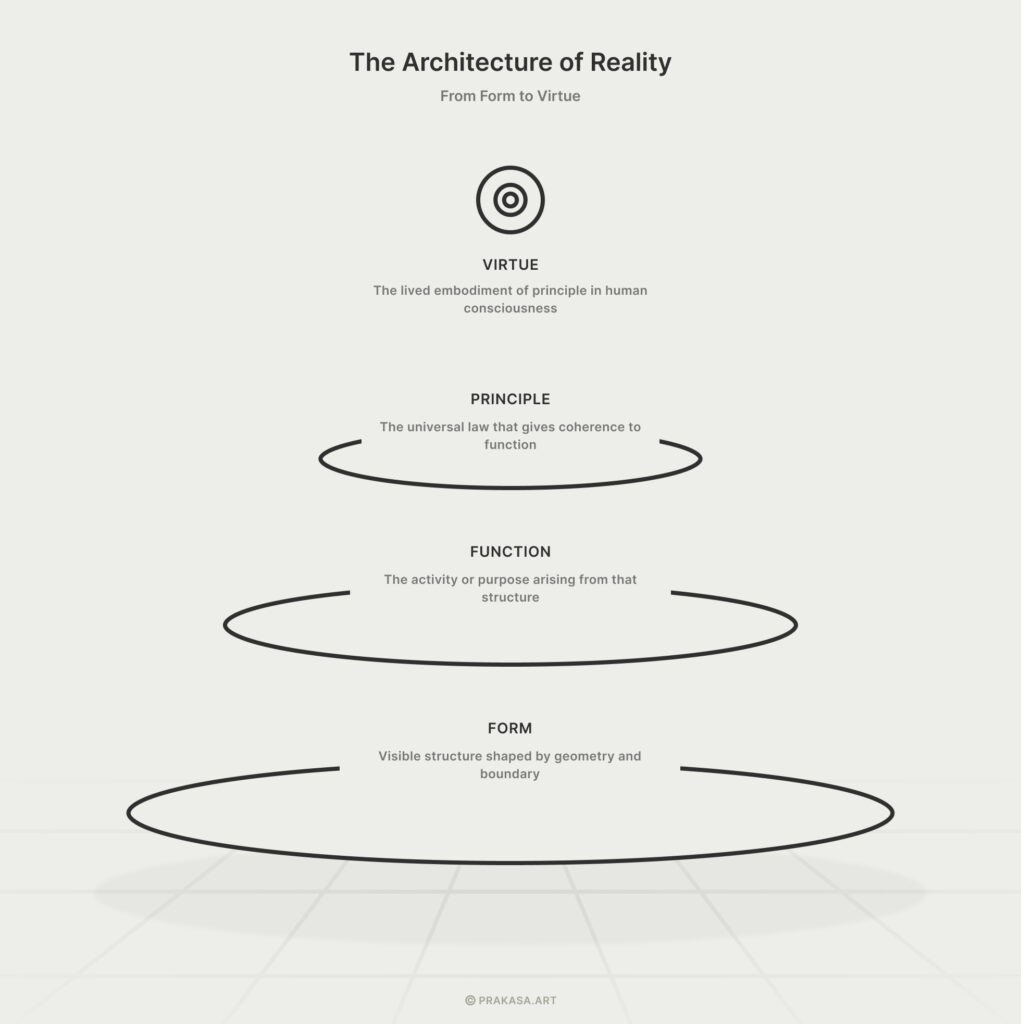
The Architecture of Reality From Form to Virtue
The diagram above expresses a universal architecture model, one recognised across traditions and articulated here through the Prakasa lens. It describes how meaning unfolds in reality as an observable sequence through which life teaches, refines, and reveals.
Let us begin with the anatomy of the progression itself.
- Form is the visible and structured aspect of reality, matter shaped by geometry, intention, and boundary.
- Function is the activity that emerges from form, the purpose it enables and the role it performs within a greater whole.
- Principle is the underlying law that governs function, the universal order that gives coherence and meaning to action.
- Virtue is the human realisation of that principle, the lived quality it calls forth in us, the sacred attribute awakened through experience.
Contemplated cyclically, this is a living feedback loop with reality. Once embodied, virtue reshapes perception and behaviour. That altered awareness gives rise to new forms of being, revealing deeper functions and more refined principles. Wisdom, in this way, returns to guide form anew.
This ladder of meaning appears with remarkable consistency across civilisations. In the Vedic tradition, dharma is both cosmic law and lived rightness, the order that sustains the universe and the quality that sustains the human being within it. In classical Greek thought, eidos gives rise to telos, guided by logos, culminating in aretē, excellence expressed as virtue. Across traditions the intuition is unified: the architecture of reality is meaningful and resonant.
To see life through this lens is to approach the world sacramentally. Matter is not mute. It speaks, if we are willing to listen. A door that will not open may be more than a material obstacle. It may be timing, redirection, or a demand for patience. A traffic jam can be understood as an invitation into presence.
This is not superstition nor simplistic allegory. It is a metaphysical stance that recognises pattern and purpose within unfolding events. Structure, like language, conveys meaning. The world is eloquent to the mind that listens.
This same layered order also mirrors the structural logic explored in Harmonic Resonance Technology, where reality is described as a sequence of geometric substrate, intelligent activity, governing pattern, and coherent participation. In this sense, virtue is not separate from technology. It is the interior condition that allows higher architectures of coherence to be recognised and, in time, responsibly engaged.
The Feedback Loop with Reality and How Life Mirrors Our Lessons
Each of us participates in a constant feedback-loop with reality. Situations present themselves, we respond, and the world “answers back”. In this exchange, virtues become visible. Consider this suite of aphorisms as a set of interpretive keys:
- What is delaying you is teaching you patience.
- What is frustrating you is teaching you calm.
- What is angering you is teaching you self-control.
- What is worrying you is teaching you trust.
- What is rejecting you is teaching you self-worth.
- What is changing around you is teaching you adaptability.
- What is scarce for you is teaching you resourcefulness.
- What is abundant for you is teaching you stewardship.
- What is loss for you is teaching you gratitude for what remains.
This list continues indefinitely, mapping nearly every human trial onto a corresponding spiritual virtue. The formula is simple, yet spiritually profound: circumstance as catalyst, feedback as revelation, virtue as outcome. Aphorisms like these invite us to shift from complaint to contemplation, from reactivity to revelation. The question is no longer “Why is this happening to me?” but “What am I being asked to learn here?” The moment you feel the energetic signature of a situation, its pressure, tempo, texture, you can usually name the virtue it points towards.
Love as the Root Virtue and the Fractal of Virtues
All virtues, no matter how diverse, are fractal expressions of love. Love is the primal resonance of the divine, it is the unified field from which all virtues emerge. But in the matrix of space-time, that singular love becomes fractalised, segmenting into differentiated qualities, so that consciousness can study its constituent faces.
- Patience is love’s relationship with time.
- Courage is love’s fidelity in the face of fear.
- Discipline is love’s devotion to what matters.
- Humility is love’s recognition of the whole.
- Forgiveness is love’s restoration of wholeness.
- Compassion is love’s understanding of suffering.
- Gratitude is love’s memory.
Thus each virtue is a facet of love refracted through circumstance. To embody a virtue is to correct our resonance with the Whole, to tune our conduct to the Love that underwrites reality. Seen in this light, we may reinterpret Prakasa’s original insight with renewed clarity:
“Form discloses beauty, function manifests harmony, principle affirms truth, and virtue awakens love.”
The Divine Curriculum
To approach life as a curriculum of virtues, we need a method, a way to “read” circumstances as lessons and to embody their teaching. Here is a clear, repeatable framework:
A) Notice the Form
Attend to the shape of the situation. Is it fast or slow? Tight or spacious? Heavy or light? Repetitive or novel? Public or private? The form gives the first clue. A slow, obstructed form differs from a chaotic, ever-changing one.
B) Name the Function
Ask: What is this doing to/for/with me? Delay slows you. Critique exposes you. Abundance expands your reach. Scarcity tightens your focus. Conflict tests your boundaries. Each function points you toward an organising rule.
C) Discern the Principle
What law is being enacted? Timing? Reciprocity? Stewardship? Non-attachment? The principle is the intelligible pattern at work.
D) Embody the Virtue
Name the virtue this principle requests e.g. patience, courage, discernment, humility, gratitude, self-worth, or stewardship, and practise it now. You accelerate growth by doing the virtue in the moment it is requested. This is timely obedience rather than post hoc reflection.
E) Close the Loop
As you embody the virtue, the form of your life shifts. New doors open; conflict softens; resources rearrange. Virtue alters behaviour, behaviour alters structures, structures reveal new principles in higher fidelity. The curriculum promotes you.
This is more than mindset; it is ontological participation. You are a co-composer in the score of your life, and virtue is the tuning that makes your instrument consonant with the whole symphony.
Obstacles, Shadows, and the Alchemy of Virtue
If life is a curriculum, then difficulties are assignments, not accidents. They are the friction that polishes the mirror. This does not trivialise suffering; it dignifies it with purpose. Three principles help to keep the learning pure:
Discernment vs Denial
Recognising the virtue being asked of us is not the same as excusing harm. “Unfairness teaches justice” does not mean we accept abuse; it means we practise justice with courage and clarity while protecting ourselves and others. The principle of love always includes boundaries.
Pace and Compassion
Virtue is not about performance; it is about resonance. Choose small, timely acts over grand, unsustainable gestures. Spiritual maturity is revealed in the ability to honour the next right step with humility and gratitude.
Integration
Virtue begins in thought, but becomes real through form. Practise in the body, speech, and intention. Through repetition, virtue crystallises and becomes embodied, integrated, and alive.

Transcendental Graduation
What is the endpoint of this divine curriculum? Not an escape from the world, but a transfiguration within it. Graduation in life’s sacred school of duality is the dawning of recognition, the moment you perceive that the world has always been an icon of the Divine, and that you, made in Its image, are both student and syllabus, reader and text.
When virtue matures, love remembers itself. The many return to the One. Patience, humility, courage, justice, gratitude, and joy dissolve back into love’s single flame, and living becomes effortless service. You move from lesson-taking to lesson-being. Your presence itself becomes the teaching, radiating a quiet and natural order.
In truth, virtue is the living frequency signature of the Divine, the bridge between intention and embodiment, where principle becomes presence.
By recognising and embodying the virtues seeded within everyday experience, we participate in the cosmic choreography of evolution, reclaiming our divinity and graduating, at last, into conscious co-creation with the One from which all arises.
To live this way is to realise that graduation is already present. It appears as deeper simplicity, quieter courage, and a steady joy that needs no reason. It is love remembered, one embodied virtue at a time.
Join the Inner Circle
Enjoyed this article? Join the Inner Circle for more reflections, quiet revelations and early access to new releases.
No spam. Just meaningful updates from Prakasa. By subscribing, you agree to receive occasional emails. You can unsubscribe anytime. Legal Policy.