


The Mystery of Water Memory
Water is often described as the elixir of life, sustaining all living beings and playing a crucial role in planetary and biological ecosystems. However, beyond its fundamental biochemical and physical properties, there exists a more profound and controversial discussion, the idea that water has memory and that human consciousness can influence its molecular structure. This notion has been explored through the pioneering work of Dr. Masaru Emoto, contemporary researcher Veda Austin, and other scientists investigating water’s sensitivity to intention, vibration, and environmental stimuli.
The Work of Masaru Emoto
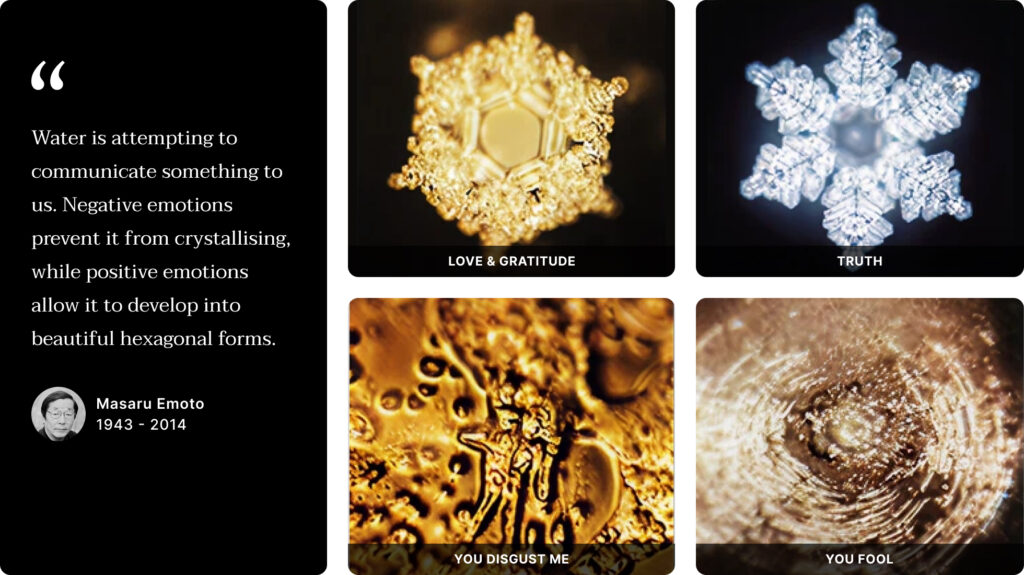
Dr. Masaru Emoto (1943–2014), a Japanese researcher, revolutionised the study of water memory with his crystallographic experiments. Through high-speed photography, he demonstrated that water molecules exposed to different words, thoughts, and emotions form distinct crystallised structures when frozen.
His findings suggest that:
- Positive intentions, such as love and gratitude, produce harmonious and aesthetically beautiful ice crystal formations.
- Negative emotions, like anger and hatred, lead to chaotic, fragmented, or distorted structures.
- Music and prayer also impact water’s molecular arrangement, with classical compositions fostering symmetry and heavy metal or discordant sounds creating disordered formations.
These results imply that water is a medium capable of storing vibrational energy and responding to human consciousness. While Emoto’s work has faced skepticism from the scientific community due to methodological concerns, it has inspired further inquiry into the relationship between consciousness and material reality.
Veda Austin’s Contemporary Research
Building on Emoto’s legacy, researcher Veda Austin has developed what she calls Collective Molecular Photography (CMP), a technique that captures the imprint of human intention on water through crystallographic imaging. Her methodology involves freezing thin layers of water under controlled conditions and analysing the resulting ice formations to reveal distinct patterns.
Key observations from Austin’s research include:
- Water forms unique signature patterns based on its source, whether spring water, tap water, or rainwater.
- Water appears to respond to thought and intention, creating structured imagery that aligns with projected emotions or visual influences.
- Water exhibits three stages of freezing, with the initial phase revealing the clearest and most intricate crystalline patterns, likened to pranic or life-force energy.
Austin’s work suggests that water not only holds memory but also actively communicates through structured formations, supporting the idea of water as a conscious, responsive entity.
The Scientific Basis for Water Memory
While the mainstream scientific community remains skeptical of water memory, several theoretical and experimental studies offer possible mechanisms:
1. Quantum Coherence and Water’s Fourth Phase
Dr. Gerald Pollack, a researcher at the University of Washington, has identified a fourth phase of water beyond the traditional solid, liquid, and gas states. This structured phase, often referred to as Exclusion Zone (EZ) Water, exhibits unique properties, such as increased order, charge separation, and responsiveness to electromagnetic fields. This structured water may act as a medium for storing and transmitting information.
2. Electromagnetic Influence and Vibrational Memory
Water molecules can form dynamic hydrogen bond networks influenced by electromagnetic radiation, including human biofields (subtle energy fields produced by living organisms). Studies in biophoton emission, light signals emitted by cells, suggest that biological systems communicate through quantum coherence, potentially affecting water’s structural integrity.
3. Cymatics and Frequency Effects
Cymatics, the study of how sound and vibration shape matter, provides further insight into water’s responsiveness to frequency. Water exposed to different sound frequencies forms distinct geometric patterns, reinforcing the idea that vibration, including human thought, which has an electromagnetic frequency, can shape water’s molecular structure (read more about cymatics here).
Implications for Human Health and Consciousness
Given that the human body is composed of approximately 60-70% water, the implications of water memory extend to health, wellness, and consciousness:
- Intentional Water Consumption: Drinking water infused with positive intention may enhance cellular vitality and well-being.
- Therapeutic Water Rituals: Practices such as structured water therapy, sound healing, and hydrotherapy align with ancient traditions that recognise water’s vibrational sensitivity.
- Environmental Consciousness: If water retains memory, pollution and negative environmental influences may impact global water quality at a more profound level than previously understood.
The Power of Thought on Our Bodies
The research on water memory aligns with the broader philosophical and scientific discussion of mind over matter, the idea that consciousness and intention can influence physical reality. If water, as a medium, responds to emotions and thoughts, then it follows that our own bodies, composed primarily of water, are also affected by our mental states.
- Positive thought: Positive thoughts and emotions create a physiological environment conducive to health, cellular regeneration, and overall well-being. Studies in psychoneuroimmunology have shown that stress, negativity, and pessimism can weaken the immune system, whereas optimism and mindfulness can enhance bodily resilience.
- Negative thought: Negative thinking and emotional turmoil may lead to cellular disharmony, increased inflammation, and even chronic diseases. This suggests that consistent negative mental patterns could structurally affect the body in ways similar to Emoto’s disorganised water crystallisations.
- Conscious Living and Intentionality: Just as water structures shift with external influences, human cells might also resonate with higher frequencies of positivity, gratitude, and love. This underscores the importance of conscious awareness, mindfulness, and intentional living.
Bridging Science and Spirituality
Water memory remains a topic at the intersection of science, metaphysics, and spirituality. While mainstream physics and chemistry have yet to fully validate these phenomena, ongoing research by pioneers like Emoto and Austin invites us to reconsider the profound, living intelligence of water. By acknowledging the potential of human consciousness to influence the material world, we open the door to deeper explorations of reality, interconnectedness, and the hidden mysteries of nature.
The Future of Water Consciousness Research
As scientific tools advance and interdisciplinary research expands, water’s role as a medium for consciousness and memory may gain greater empirical validation. Whether through quantum mechanics, vibrational resonance, or structured molecular states, the potential for water to bridge the physical and energetic realms offers a profound opportunity to understand the nature of life itself.
Water, as both a fundamental element and a dynamic medium, continues to invite us into a deeper dialogue with our own consciousness, urging us to listen, observe, and respect the intelligence it may hold within its flowing currents. More than ever, this research reminds us that our thoughts are powerful, capable of shaping not just our inner world but also the fabric of reality itself. By cultivating awareness and choosing positivity, we can create harmony not only within ourselves but also in the world around us.
Join the Inner Circle
Enjoyed this article? Join the Inner Circle for more reflections, quiet revelations and early access to new releases.
No spam. Just meaningful updates from Prakasa. By subscribing, you agree to receive occasional emails. You can unsubscribe anytime. Legal Policy.