

Beyond the Board
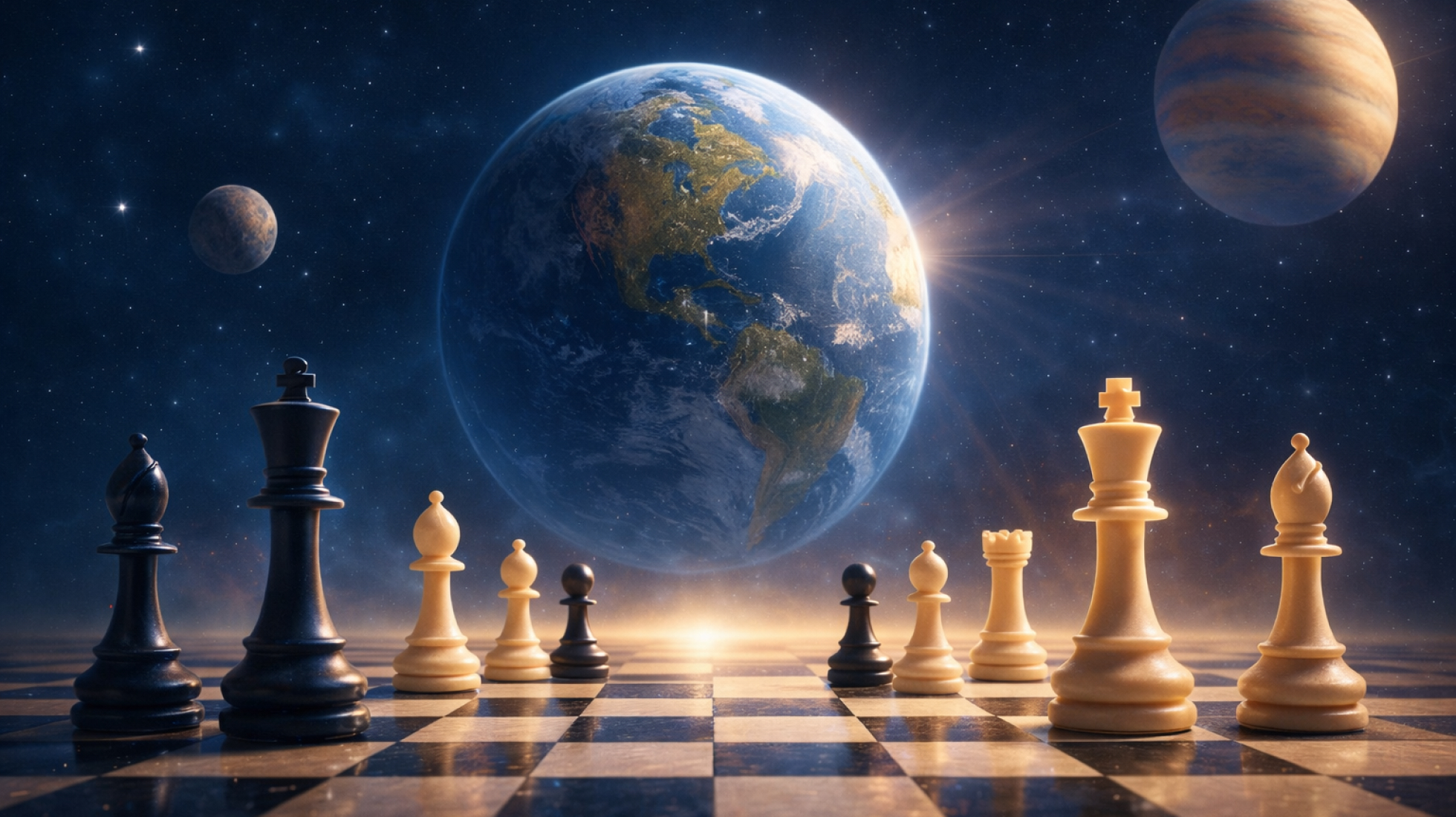
In the hush of a chess match, where wooden pieces glide across 64 squares and two minds engage in silent dialogue, there unfolds a story far vaster than the game itself.
“Chess is not merely a game. It is a mandala for the mind, a temple for the spirit, and a field of awakening for the soul.”
Chess is more than an intellectual contest. It is a living mandala, a reflection of the universe in miniature, echoing the deep patterns of nature, consciousness, and cosmic order.
At its heart lies a field of infinite potential: the chequered 8×8 grid, a symbol that pulses through genetics, sacred geometry, computing, divination, and ancient metaphysics.
Through this archetypal stage, chess becomes a microcosm, a fractal slice of the whole, where each move mirrors the choices, limitations, struggles, and transcendence of life itself.
Let us step into this field of play and explore how chess, in its elegant simplicity, becomes a profound meditation on existence.
Origins in Vedic Chaturanga and Vastu’s Sacred Square
What we now call chess emerged from the Vedic game of Chaturanga, played on the same 8×8 grid. Meaning “four divisions,” it represented the four arms of the ancient army; infantry, cavalry, elephants, and chariots, precursors to pawns, knights, bishops, and rooks. Yet Chaturanga was more than military strategy. Its board was a mandala of order and polarity, a theatre where human decision-making mirrored dharma, balance, and fate.
This resonance deepens when seen through the lens of Vastu Shastra, the ancient science of space and harmony (learn more about the science of Vastu Science). At its heart lies the Manduka Mandala (the Chaturasra), an 8×8 grid that encodes cosmic order, the field of all possibility, where the forces of creation and dissolution find equilibrium. Just as temples and dwellings were designed upon this mandala to anchor universal balance into physical form, Chaturanga may be understood as a portable mandala, a living yantra where those same principles were enacted in play.
Chess inherits this symbolism. Each square becomes a point of polarity, black and white interwoven, reminding us of the eternal dance of opposites: light and shadow, order and chaos, creation and destruction. To play is, in essence, to enter the ritual of balancing these primordial energies, a contemplative act where worldly contest echoes cosmic truth.
64 as a Universal Constant
The chessboard, with its 64 squares, is far from arbitrary. Across cultures and sciences, the number 64 recurs wherever a complete field of possibility or transformation is required. In biology, the human embryo passes through a 64-cell stage, a moment of critical complexity and potential. In the I-Ching, 64 hexagrams map every archetype of change along the human journey. In genetics, 64 codons encode the full spectrum of amino acids that underpin all life. In computing, 64-bit systems and Base64 encoding shape how information is stored and shared. In sacred geometry, the 64-tetrahedron grid and the 64-square vector equilibrium form the foundation of universal design.
This constellation of correspondences is no coincidence. The number 64 belongs to a larger family of archetypal grids, interference fields through which nature builds form. The smaller numbers sketch the alphabet of creation: 2 gives the seed of polarity, the primal division into yin and yang; 4 stabilises this polarity into the cross, the first balanced field; and 16 offers the proto-life lattice, a structural matrix found in crystals and DNA bases.
Then arises 64, the life hologram itself. The lesser numbers are akin to letters; in 64 they gather into a word, whole and resonant, capable of holding the blueprint of life across physics, biology, and consciousness. Beyond this threshold, the lattice continues its song, expanding in powers of two, 256, 512, 1024, each a higher octave in the spiral of becoming, each unfolding as a vaster harmony in the continuum of creation. What follows is the sequence of archetypal thresholds, the key transformative stages of form most widely echoed across traditions, even though subtler numbers like 8, 32, and 128 serve as harmonic bridges between them. This unfolds as a ladder of life holograms:
- Polarity (2)
- Balance (4)
- Proto-Life (16)
- Biological Life (64)
- Meta-Life (256)
- Cosmic Life (512)
- Universal Life (1024)
The chessboard, with its 64 squares, is thus not an accident of design but a threshold: the point where form becomes rich enough to echo life itself. To sit before it is to enter a mandala of possibility, a ritual ground where the universe writes its living code one move at a time.

Chess as a Symbolic Map of Human Existence
The Geometry of Being
Each chess piece is bound by its geometry. Pawns step forward, knights leap in L-shapes, bishops glide diagonally. Their powers and restrictions echo our own: our bodies, psychology, upbringing, and circumstances shape what is possible in any given moment. Yet, within these boundaries, creativity flourishes. The rules are fixed, but strategy, like the human spirit, is endlessly inventive.
“Limitations are the canvas upon which freedom is painted.”
The Dance of Opposites
The black-and-white pattern of the chessboard is the archetype of polarity. In the movement of light and shadow, day and night, yin and yang, chess reminds us that all existence is a dance of opposites.
“Success in chess and in life emerges from dynamic equilibrium: knowing when to yield, when to advance, and when to hold the centre.”
Mirrors of Society and Soul
Each chess piece embodies a role, a facet of society, and a part of the human psyche:
- Pawns: The multitude, the seed of potential, those who move step by step, but can, through perseverance, transform utterly
- Rooks: The guardians of order, representing infrastructure, boundaries, and the stability of civilisation
- Knights: The warriors, agents of unexpected change, moving in unorthodox ways, courage and agility embodied
- Bishops: The spiritual, the visionaries, gliding across diagonals, cutting through the ordinary to touch the sacred
- Queen: The creative force, the embodiment of power and flexibility, weaving across the board as inspiration incarnate
- King: The axis, the centre of gravity, around which all else revolves; vulnerable, precious, and ultimately the purpose of the game
Every pawn begins its journey at the edge of the board, limited in power but rich in potential. With perseverance and purpose, it can cross boundaries and, in a moment of arrival, transform utterly. In this, the story of the pawn becomes a metaphor for the path of human growth, self-realisation, and transcendence.
Time, Mortality, and the Pulse of Play
Every chess game unfolds within the measure of time. The turn-based rhythm echoes the cycles of breath, heartbeat, and life itself. The clock ticks, urging decisiveness, reminding us of impermanence. The tension between deliberation and action becomes a meditation on mortality.
“In life, as in chess, procrastination and haste carry consequences; wisdom lies in navigating time’s relentless current with grace.”
Determinism and Free Will
Chess operates on fixed rules, movement is strictly determined. And yet, within these bounds, the possible games outnumber the atoms in the universe. This is the mystery of existence: karma and circumstance define the field, but free will animates the dance. Destiny and choice are not opposites, but partners in creation.
Death, Rebirth, and the Equality of Endings
Captured pieces leave the board, momentarily removed from play. Yet, at game’s end, all return to the same box, their status dissolved, distinctions erased.
“This is the universal cycle of life and death: kings and pawns, queens and knights, all are equal in the embrace of wholeness.”
Holding Balance in Chaos
In both chess and cosmology, the centre is vital. Control of the central squares confers strength, mobility, and balance. In yogic philosophy, the central axis, the sushumna, the still point, offers access to expanded awareness and flow.
Likewise, the chessboard teaches: those who hold the centre hold the key. Whether in strategy, in life, or in the cosmos, the centre is the place of power, harmony, and integration. The journey outward always returns to this axis.
Infinite Outcomes from Finite Rules
From the modest field of 64 squares and 32 pieces, chess unfolds into a cosmos of possibility. Mathematicians estimate that the potential games, the so-called “game tree,” exceed the number of atoms in the observable universe. Out of fixed rules and finite boundaries, infinite outcomes are born, mirroring the abundance of the universe itse
This principle is echoed in John Conway’s Game of Life, where an 8×8 grid and a few simple laws generate endlessly evolving patterns, blossoming, mutating, dissolving. Both games remind us of the same truth: that simplicity births complexity, that boundaries give rise to the boundless. As in sacred geometry, as in the dance of DNA, as in the art of living, the finite is the seed of the infinite.
Chess, Art, and the Contemplative Mind
For the conscious seeker, chess becomes more than competition. It is a living art, a contemplative practice, a sacred space for the cultivation of presence, strategy, and self-awareness.
- Each move is a mantra, a decision, an intention, a ripple in the field
- Each match is a story, of ambition, loss, sacrifice, renewal
- Each victory and defeat is a lesson in humility, impermanence, and growth
The 64 squares invite us to become artists of our own existence, to see limitation not as prison, but as potential, to meet the dualities of life with grace, to strive for the centre, the axis of wholeness, and, when the game ends, to remember the equality and unity beneath all difference.
Chess as a Mandala for Modern Living
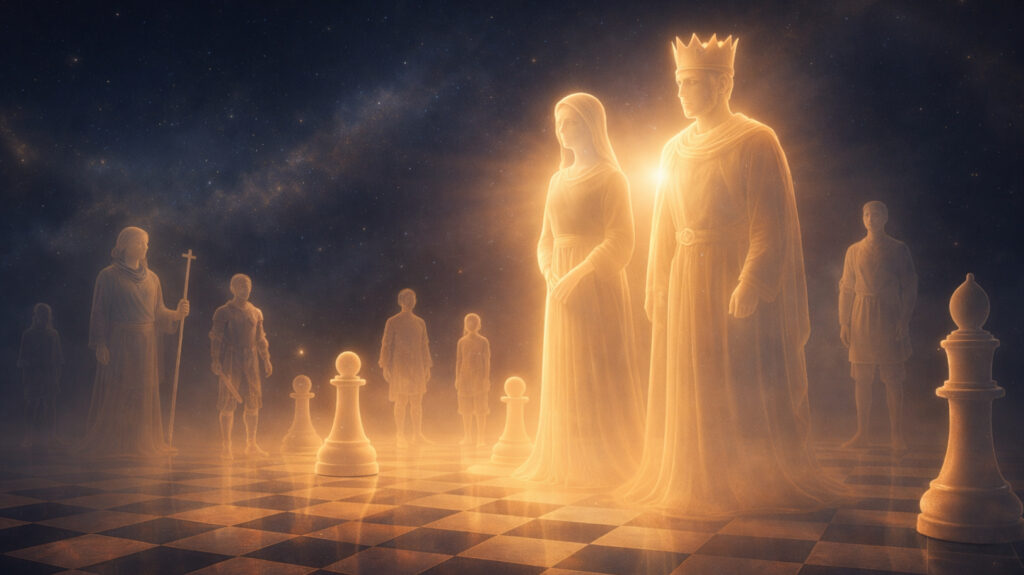
In a world increasingly defined by complexity and polarity, the chessboard offers a rare gift, a contemplative mirror through which to glimpse the order underlying apparent chaos.
It invites us to become both player and witness, strategist and artist, hero and humble pawn.
To sit before the board is to enter the sacred theatre of existence, to practise presence, and to participate in the dance of possibility that echoes through all things.
In this ancient game, geometry and consciousness meet, time and eternity merge, and the secret of life reveals itself, one move at a time.
Join the Inner Circle
Enjoyed this article? Join the Inner Circle for more reflections, quiet revelations and early access to new releases.
No spam. Just meaningful updates from Prakasa. By subscribing, you agree to receive occasional emails. You can unsubscribe anytime. Legal Policy.