




Sacred Architecture and the Geometry of Cosmic Order
Temples stand as architectural testaments to humanity’s deep-rooted understanding of sacred geometry, cosmic alignment, and vibrational intelligence. Across civilisations, from the temples of India to the pyramids of Egypt and the stepped pyramids of Mesoamerica, we find a recurring pattern: an intricate fusion of mathematics, spirituality, and science. The Vastu Shastra, the ancient Vedic science of architecture, is woven into many of these structures, demonstrating not only its antiquity but its resonance with a universal architectural language. These sacred spaces were not constructed arbitrarily. They were designed as living diagrams of cosmic order, reflecting the fractal relationship between the microcosm and the macrocosm.
Mathematical Precision in Temple Construction
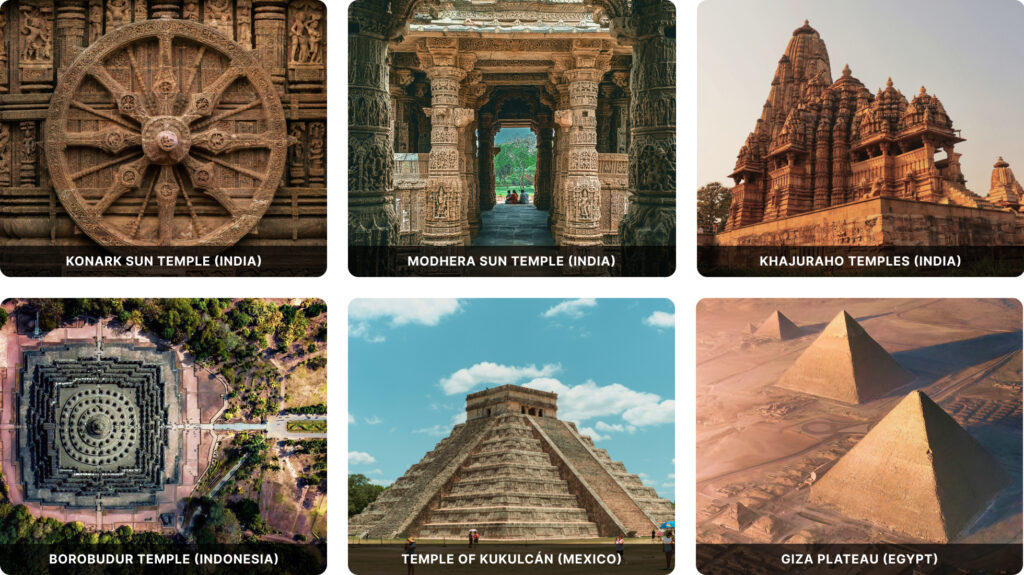
Ancient temples such as the Great Pyramid of Giza and Angkor Wat display astonishing mathematical precision. The Great Pyramid aligns closely with the cardinal directions, while Angkor Wat reflects the Vedic cosmological model of Mount Meru and aligns with solstitial movements. The El Castillo pyramid at Chichen Itza demonstrates astronomical precision through the equinox serpent shadow phenomenon. These alignments reveal that temple architecture was inseparable from celestial mathematics. Geometry functioned as calibration rather than ornament.
The Global Temple Archetype
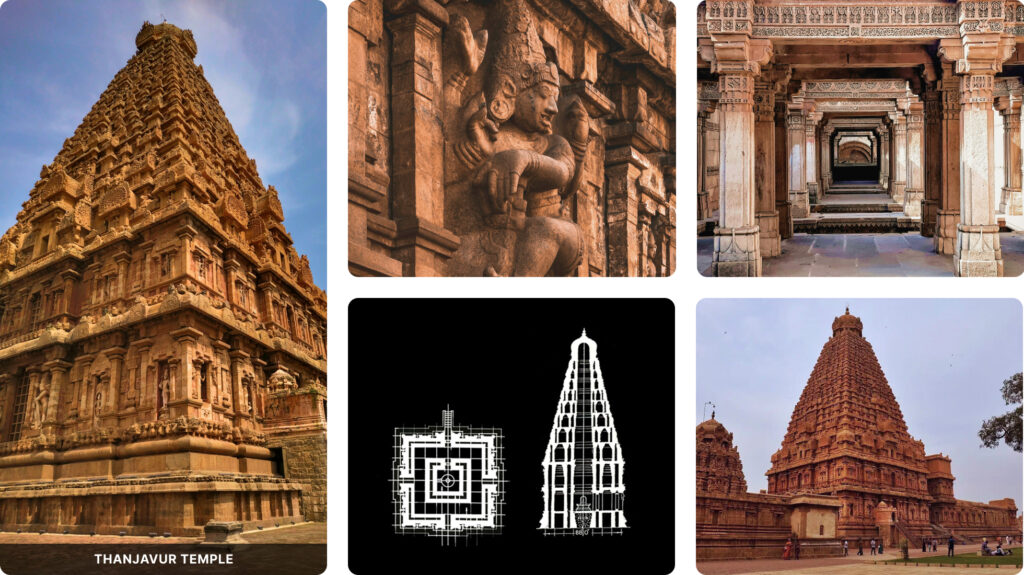
Across cultures, a recurring spatial pattern appears: an outer court, an inner chamber, and a central sanctum. In Vedic architecture, this culminates in the garbhagriha, the innermost womb chamber. In Biblical tradition, it appears as the outer court, holy place, and holy of holies. In Mesoamerican and Southeast Asian temples, similar progressive sanctification unfolds spatially.
At the core of each lies a point of stillness, a bindu. This spatial progression represents more than ritual movement. It encodes a universal initiatory geometry, guiding the individual from the external world toward the axis of inner coherence.
This shared archetype suggests that sacred architecture may emerge from a universal blueprint embedded within human consciousness itself.
The Architecture of Sacred Space
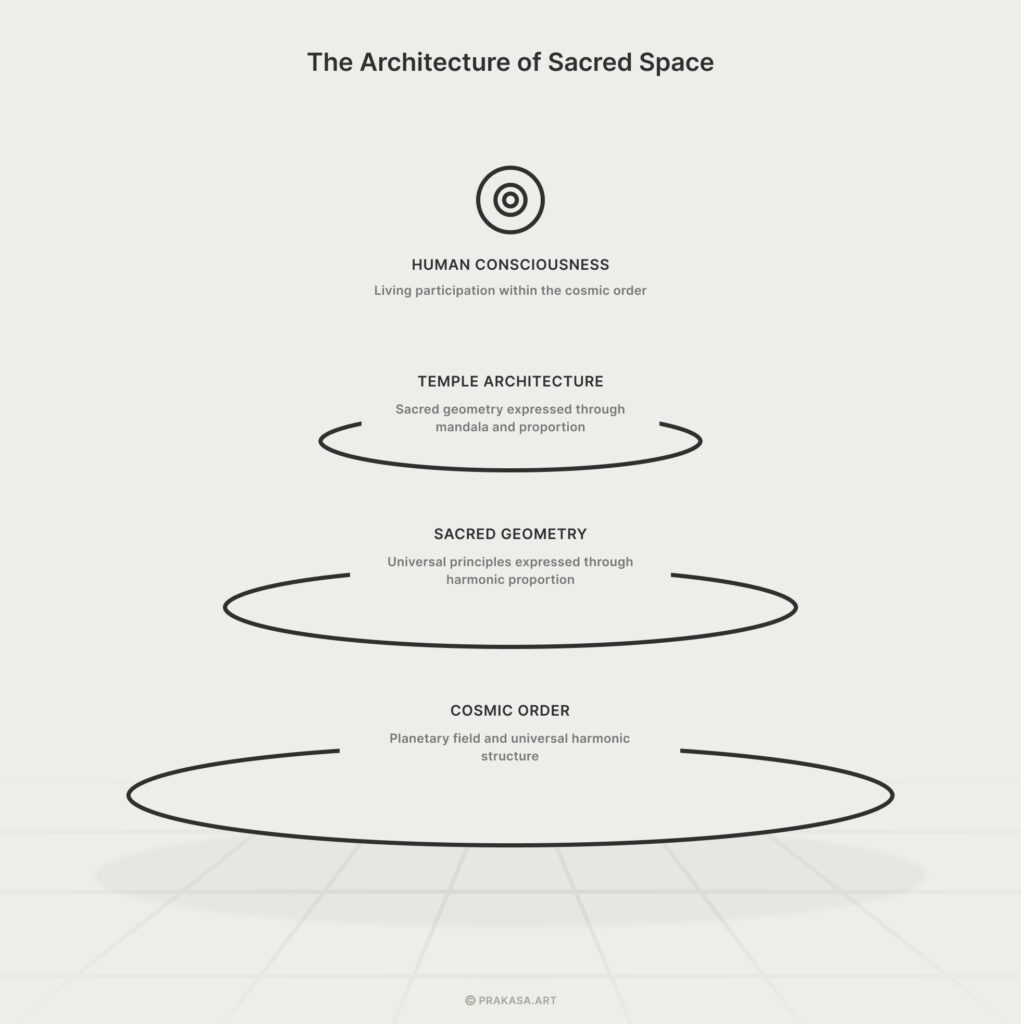
Ancient temples were conceived as expressions of a layered cosmology rather than isolated buildings. Their design reflects a progression from universal order to human experience, translating cosmic principles into architectural form.
At the foundation lies cosmic order: the planetary field and harmonic structure that governs natural phenomena. In traditional cosmology this order is understood as the organising intelligence of the universe, the invisible framework through which celestial motion, natural rhythms, and energetic balance unfold.
From this cosmic order arises sacred geometry. Proportional systems, geometric ratios, and mandala grids translate universal principles into measurable spatial form. These patterns function as the mathematical language through which cosmic harmony becomes spatial structure.
Temple architecture then expresses this geometry in physical form. Through orientation, proportion, and carefully structured spatial progression, the temple becomes a three-dimensional mandala. Walls, columns, chambers, and sanctums are arranged to mirror the same harmonic relationships encoded in geometric diagrams.
At the highest level stands human consciousness. The temple is ultimately experienced through the awareness of those who enter it. As individuals move from the outer spaces toward the central sanctum, they symbolically journey from the outer world toward an inner axis of stillness. In this way, architecture becomes a bridge between cosmic order and human perception.
Seen through this lens, sacred architecture functions as a living interface between the cosmic order and human awareness. The temple is not simply a place of worship but a geometric instrument designed to align consciousness with the deeper order of the cosmos.
It is within this context that yantras and mandalas emerge. These diagrams encode the same structural principles in symbolic form, serving as the geometric blueprints from which sacred architecture unfolds.
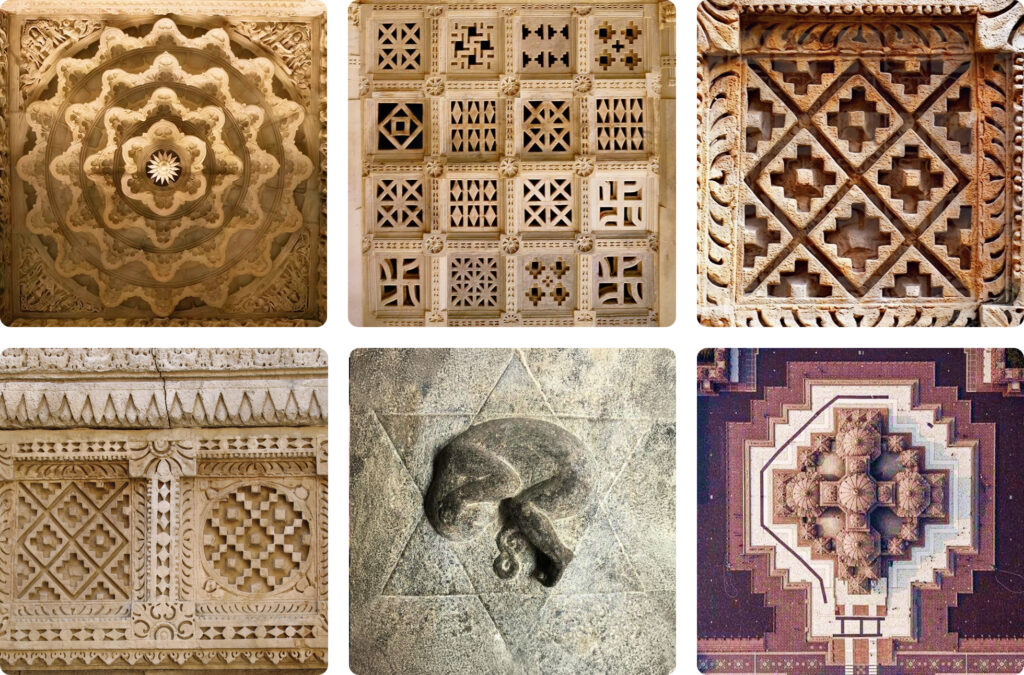
Yantras, Mandalas, and the Universal Blueprint
Vedic temples are often constructed using mandalas and yantras, geometric diagrams that represent the cosmic structure of reality. Central among these is the Vastu Purusha Mandala, typically expressed in its 8 x 8 Manduka configuration. This grid aligns the physical structure with directional forces, elemental balance, and cosmic proportion.
Yet the mandala functions on more than a symbolic level. It encodes a structural logic. The Vastu Purusha, the universal body upon which the mandala is based, may be understood as a template of ordered energy. Ancient architects worked from the principle that macrocosm and microcosm share structural order. The same proportional relationships governing celestial motion were understood to operate within the atom and the human body.
To build in harmony was to replicate this innate structural intelligence. Temple, home, craft, and even early forms of technology were designed to mirror the geometry of the atomic and cosmic blueprint. Architecture became a scaled expression of universal order.
For a deeper exploration of how Vastu geometry encodes harmonic architecture, see Vastu Science and the Bioresonant Designs of Rishi Prakasa.
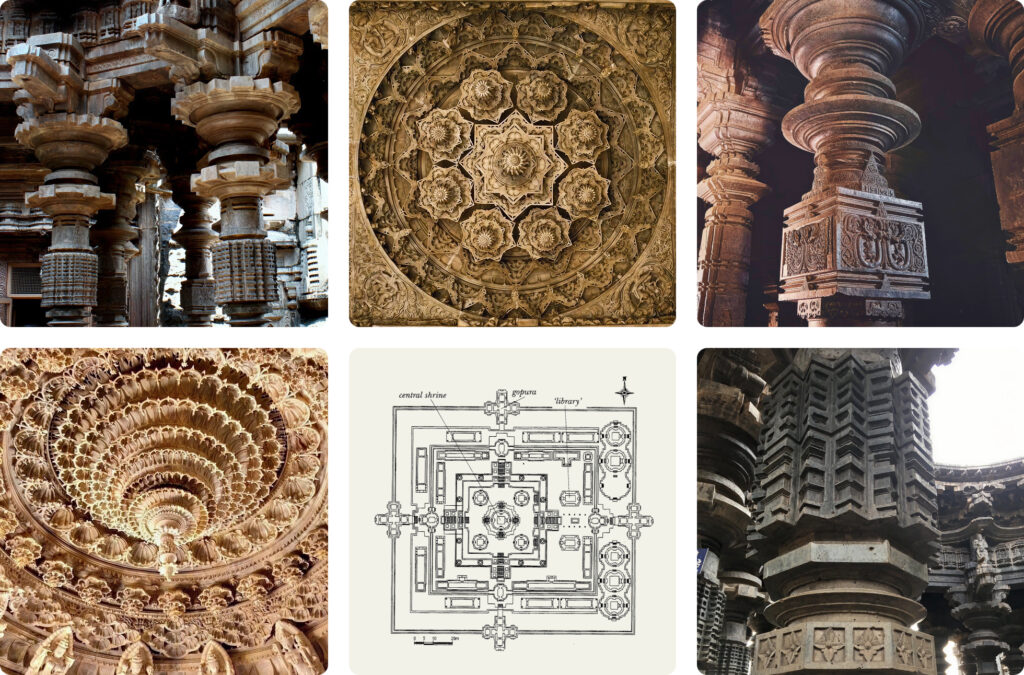
Energy Fields and Architectural Circuitry
Ancient temples were designed for worship and resonance. Structures such as the Kailasa Temple in Ellora and the Lingaraj Temple in Odisha demonstrate how architecture can channel and amplify energy through proportion, material, and orientation.
These spaces may be understood as large-scale geometric circuit systems. Just as a modern microchip routes electrical current through patterned pathways, temple complexes route acoustic, electromagnetic, and geomagnetic forces through spatial design. Stone corridors, vaulted chambers, mineral compositions, and directional alignments together form a coherent field architecture. Geometry becomes circuitry.
Recent archaeological discoveries deepen this perspective. Beneath the Temple of the Feathered Serpent at Teotihuacan, pools of liquid mercury were found sealed within subterranean chambers. Mercury, a conductive and reflective element, interacts uniquely with electromagnetic forces. Its presence suggests that temple builders were not merely symbolic architects but practitioners of material resonance. Whether ceremonial, technological, or both, such inclusions indicate an awareness that architecture could interface directly with subtle environmental fields.
Water features in temple complexes may be viewed through a similar lens. Reservoirs, stepwells, and purification pools functioned as both ritual devices and environmental stabilisers. Water is responsive to vibration, pressure, and electromagnetic influence. When structured by geometry and intention, it becomes a medium of coherence. Readers who wish to explore this dynamic further may refer to Exploring Water Memory and its Molecular Sensitivity to Human Thought, which examines how fluid systems respond to informational patterning.
Likewise, the acoustic dimension of temple design reveals how frequency shapes form. Mantras, chants, and harmonic reverberation within stone chambers generate standing wave patterns that interact with structure and space. The visible manifestation of vibration into geometry is explored in Cymatics: The Art and Science of Visualising Sound, where sound is seen organising matter into coherent patterns.
In this sense, temples function simultaneously as places of devotion, works of art, shelters, energy modulators, and instruments of planetary coherence. They are multidimensional architectural expressions where physics, philosophy, culture, and geometry converge.
These principles resonate with the breath-based harmonic architecture explored in The Breath of Intelligence and the Geometry of Truth, where geometry and coherence operate as living intelligence rather than mechanical abstraction.
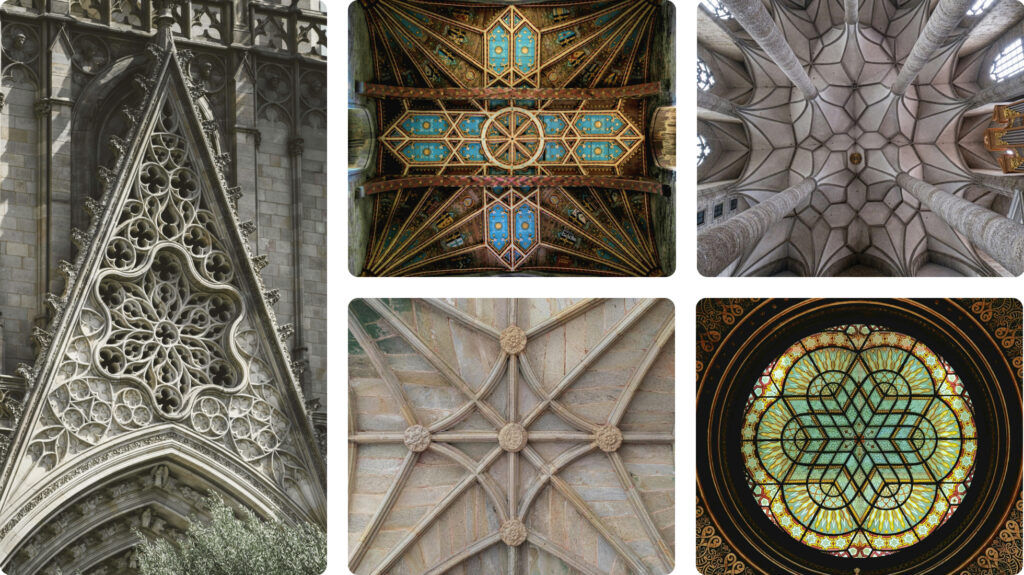
Architecture as Initiatory Text
Ancient temples and Gothic cathedrals may also be understood as stone manuscripts. Relief carvings, statues, stained glass, proportional relationships, and symbolic motifs encode layered philosophical knowledge. Alchemy was not confined to laboratory experimentation but was embedded in architecture, myth, language, and sacred proportion.
These structures functioned as artistic philosophical dwellings, leaving subtle markers for future readers of sacred geometry. The building itself becomes a layered text, readable through geometry, iconography, and spatial progression. European sacred architecture, much like Vedic temples, encodes a process of transformation within its structural design.
The Lost Technologies of Ancient Builders
How ancient builders cut, transported, and precisely placed megalithic stones remains a subject of ongoing inquiry. The Kailasa Temple, carved from a single rock, and sites such as Baalbek and Puma Punku suggest techniques beyond conventional explanations.
Some traditions describe the controlled use of acoustic vibration to influence matter. Others point toward the piezoelectric properties of granite and quartz, materials capable of interacting with pressure and electromagnetic forces.
Within certain esoteric cosmologies, it is proposed that earlier civilisations may have operated within a higher harmonic understanding of matter. Stone was not treated as inert substance but as a responsive lattice capable of phase adjustment under precise frequency input. Construction may have involved resonance alignment rather than mechanical force.
Such perspectives suggest that architecture was not executed from linear planning alone. Form was received as coherent geometric instruction. The blueprint emerged through field-based understanding rather than conventional documentation.
Why These Technologies No Longer Operate
If temples once functioned as advanced resonance systems, why do they no longer operate in the same way?
One possibility is that these technologies were relational rather than mechanical. They required coherence between practitioner and structure. The architecture did not function independently of consciousness. It operated in alignment with it.
Certain initiatory traditions describe tools that amplified intentional coherence and interfaced with Earth’s plasma fields, allowing matter to respond to directed frequency. If such systems depended upon a high degree of inner alignment, their inoperability today may reflect not structural failure but a shift in human coherence.
This suggests that conscious alignment was the source of power within these ancient technologies.

Temples as Consciousness Anchors
Temples are far more than monuments of devotion. They are resonance chambers, energy amplifiers, and cosmic timekeepers. Their geometry stabilises coherence within both individual and planetary fields.
Many researchers propose that sacred sites form part of a global energy grid aligned with Earth’s magnetic structure. On a planetary scale, sacred architecture may function as nodal stabilisers, amplifying or regulating terrestrial resonance.
In Vastu Science, spatial design operates at a planetary scale. The Vastu Purusha Mandala mirrors both terrestrial and cosmic order. Just as a home is designed for inner harmony, temples may have been constructed to align with larger geomagnetic forces, anchoring a planetary grid of coherence.
Timeless Scientific and Spiritual Marvels
Ancient temples are enduring demonstrations of integrated knowledge. They unite mathematics, astronomy, acoustics, mineral science, symbolic philosophy, and spiritual insight within a single architectural form.
They stand as reminders that architecture can function as living intelligence rather than inert structure. When proportion aligns with planetary rhythm and geometry mirrors universal order, space itself becomes an instrument of consciousness.
The principles of Vastu Shastra, embedded within these sacred structures, suggest an architectural intelligence that extends beyond cultural context. As contemporary research begins to explore vibrational physics and field coherence, the knowledge held within these temples may offer a different way of understanding the relationship between matter, perception, and geometry.
Temples remain as quiet anchors of an integrated science, where form, space, and awareness are held in deliberate relationship.
In a contemporary setting, this same intelligence can be approached through the spaces we shape around us. Geometry, when aligned with coherent proportion, begins to influence not only what is seen, but how a space is experienced.
Within this perspective, art shifts its role. It no longer sits at the edge of a room as ornament, but participates in orientation, subtle, yet perceptible over time.
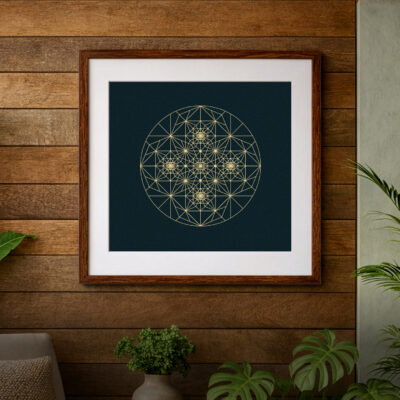
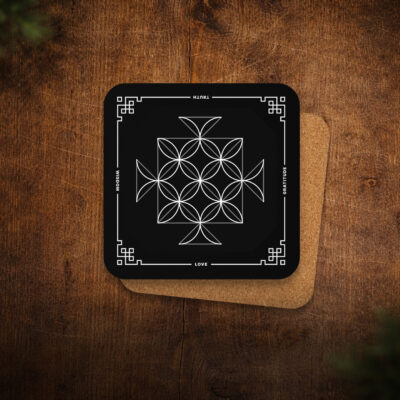
The Harmonic Wall Art collection by Prakasa draws from these architectural principles, translating proportion and pattern into forms suited to modern environments. For those who feel a resonance with these ideas, the collection offers a way to bring that coherence into everyday space.
Join the Inner Circle
Enjoyed this article? Join the Inner Circle for more reflections, quiet revelations and early access to new releases.
No spam. Just meaningful updates from Prakasa. By subscribing, you agree to receive occasional emails. You can unsubscribe anytime. Legal Policy.